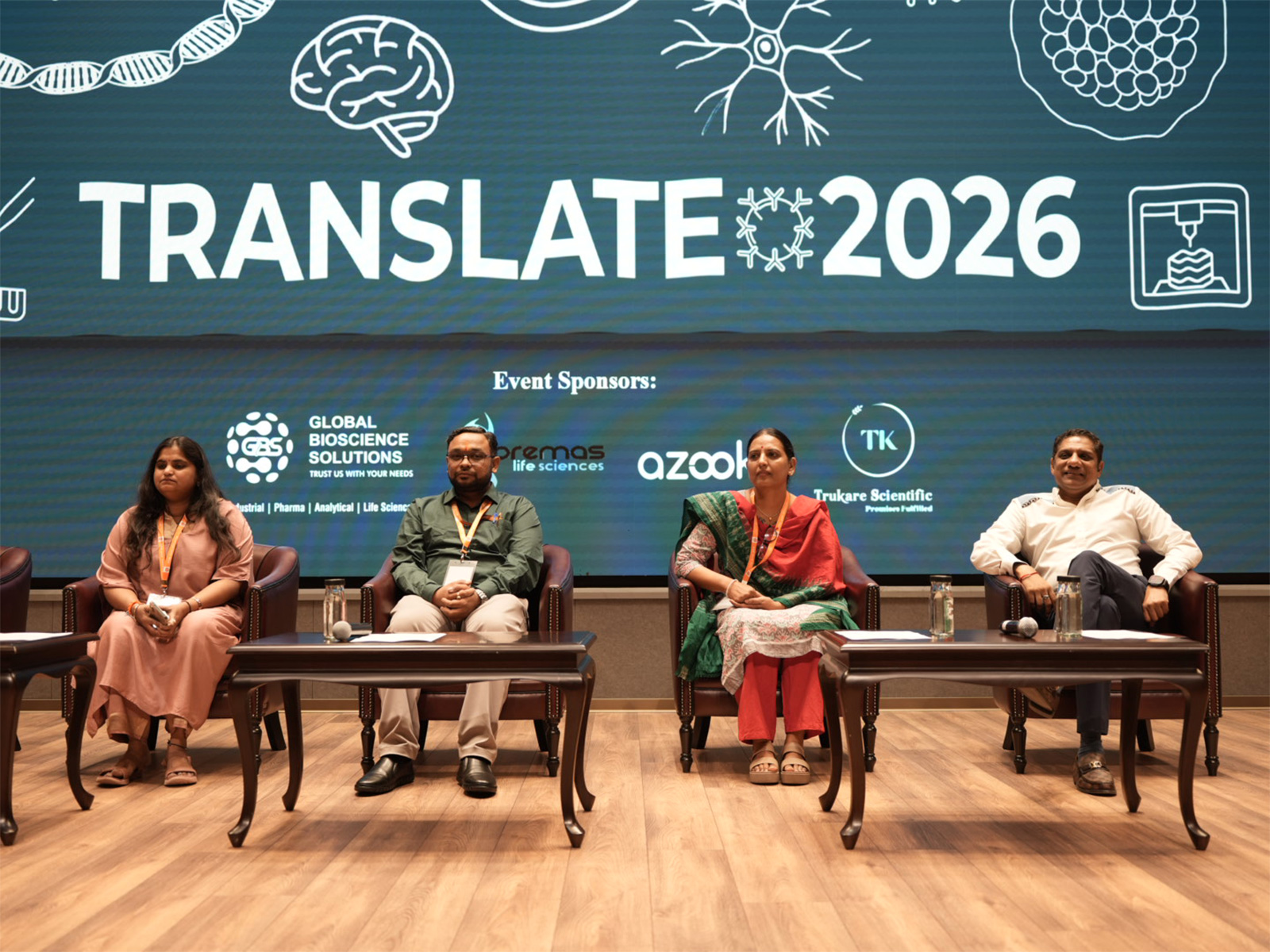
Translate 2026 at MAHE Bengaluru Showcases India's Push Toward Real-World Healthcare Innovation
May 13, 2026
NewsVoir
Bengaluru (Karnataka) [India], May 13: Manipal Institute of Regenerative Medicine (MIRM), a constituent unit of Manipal Academy of Higher Education (MAHE), an Institution of Eminence Deemed to be University, organised TRANSLATE 2026, a two-day symposium focused on accelerating the journey of biomedical research from laboratory discovery to patient care.
Supported by the Anusandhan National Research Foundation (ANRF), the symposium brought together scientists, clinicians, medtech startups, healthcare innovators, and industry leaders to explore how emerging biomedical technologies can evolve into scalable, clinically relevant, and industry-ready healthcare solutions.
At a time when healthcare systems are increasingly demanding patient-centric, technology-driven solutions, the conference highlighted the growing importance of translational research and deeper collaboration among academia, hospitals, startups, and industry. Experts at the symposium emphasised that many of the most impactful healthcare breakthroughs today emerge through interdisciplinary collaboration that connects scientific discovery with clinical and commercial application.
Inaugurating the conference, Prof. Madhu Veeraraghavan, Pro Vice Chancellor, MAHE Bengaluru, said, "Artificial Intelligence is transforming research and healthcare at an unprecedented pace, but meaningful innovation will ultimately depend on how effectively we translate knowledge into real patient impact. Platforms like TRANSLATE 2026 reflect MAHE Bengaluru's commitment to building stronger collaborations between academia, clinicians, and industry to accelerate healthcare innovation."
The symposium featured discussions on several emerging areas shaping the future of healthcare innovation, including advanced biomaterials, regenerative medicine, 3D and 4D bioprinting, tissue engineering, infection-resistant medical surfaces, and translational medical devices. Sessions explored how next-generation biomaterials and regenerative technologies are creating new possibilities in implant technologies, regenerative therapies, and biomedical devices designed for improved patient outcomes.
Industry and startup participation formed a key highlight of the event, with entrepreneurs and innovators sharing insights into the challenges of translating healthcare technologies from research environments into commercially viable and clinically deployable solutions. Discussions also focused on scaling indigenous medtech innovation, strengthening healthcare manufacturing ecosystems, and improving pathways for clinical adoption.
Speaking about the significance of the symposium, Prof. Jyothi Prasanna, Director, MIRM, said, "TRANSLATE 2026 was envisioned as a platform to bring together researchers, clinicians, innovators, and industry leaders to collectively address how scientific discoveries can be translated into meaningful patient impact. The future of regenerative medicine and biomaterials research lies in interdisciplinary collaborations that can accelerate clinically relevant and socially impactful healthcare solutions."
By bringing together voices from science, healthcare, technology, and entrepreneurship, TRANSLATE 2026 reinforced MAHE Bengaluru's growing role in advancing translational biomedical research and supporting India's emerging ambitions in medtech, regenerative medicine, and healthcare innovation.
(ADVERTORIAL DISCLAIMER: The above press release has been provided by NewsVoir. ANI will not be responsible in any way for the content of the same.)