Swedish Engineering: How Duztec Is Helping Industries Meet India's Air Quality Challenge
Jun 27, 2026
VMPL
New Delhi [India], June 27: What if one of the biggest threats to industrial productivity is not equipment failure, supply chain disruption, or rising operational costs--but the air that the workers breathe every day? Every day, lakhs of workers across India's mines, cement plants, and construction projects work in environments where airborne dust has become an accepted part of daily operations and industrial growth.
But what if dust is more than just an environmental concern? What if it is actually:
- A productivity problem that degrades heavy machinery.
- A worker's health problem that drives absenteeism and liability.
- A compliance problem that triggers costly operational shutdowns.
- An ESG problem that deters modern institutional capital.
- A business continuity problem that threatens long-term licenses to operate.
The future of industrial growth in India will not be defined only by how much industries produce, but also by how responsibly they manage what they release into the environment.
India's Industrial Growth Story Has a Hidden Cost
As India is moving steadily toward its ambition of becoming a $5 trillion economy, much of that growth will continue to be driven by large industries such as:
- Mining & Resource Extraction
- Infrastructure & Urban Development
- Heavy Manufacturing
- Civil Construction
- Logistics & Material Handling
These sectors are essential to economic progress, but they also generate substantial levels of fugitive dust emissions as part of their daily operations.
For years, industrial performance has largely been measured by output, speed, and operational scale. Today, that perspective is evolving. Regulators, environmental authorities, local communities, and stakeholders are placing greater emphasis on air quality, worker well-being, sustainability, and responsible industrial practices.
As a result, the conversation has shifted.
The question is no longer whether dust control is necessary--it is how industries can implement effective dust management strategies while maintaining productivity, operational continuity, and long-term business performance.
How Is Duztec Helping Industries Meet India's Air Quality Challenge?
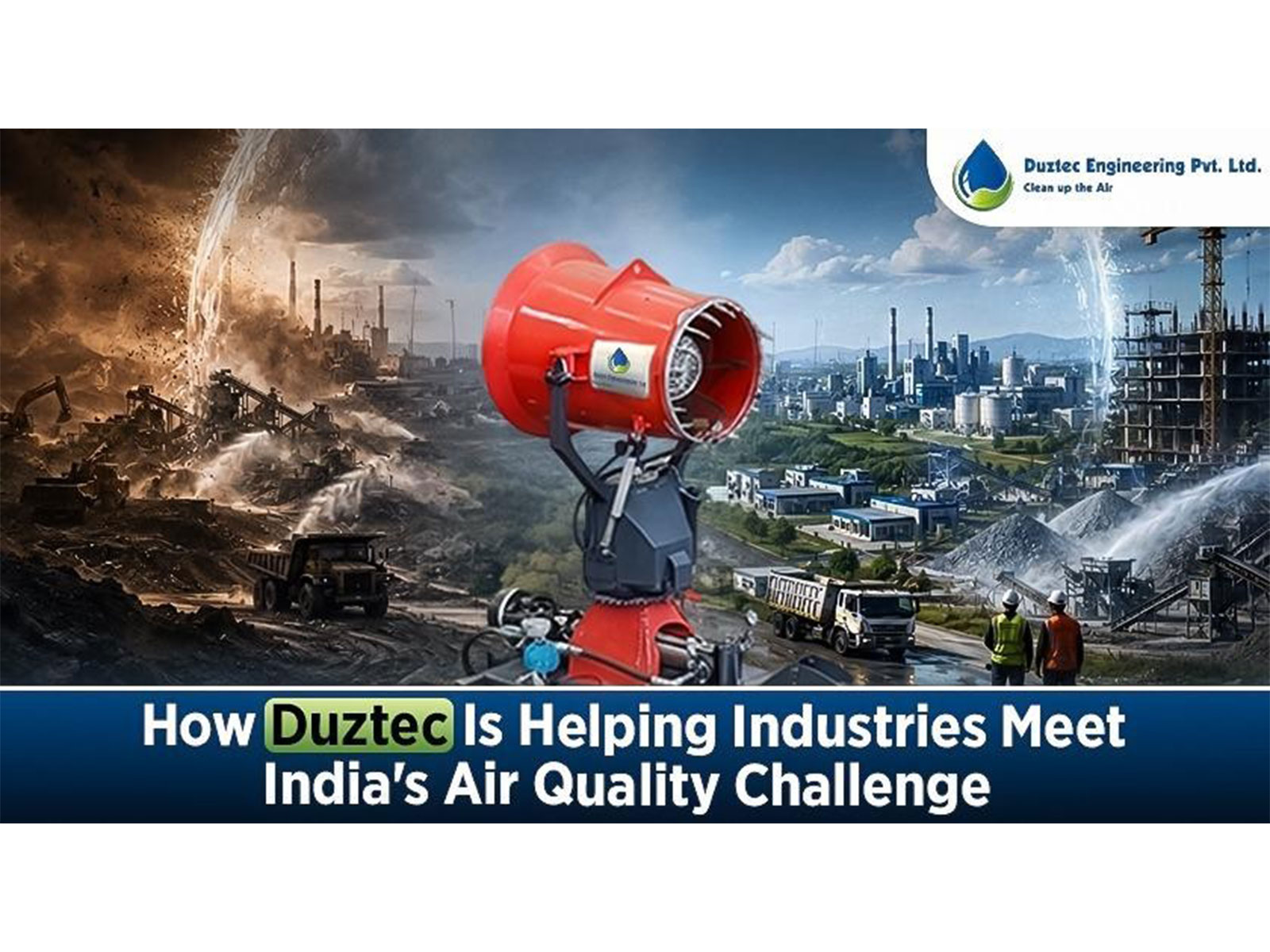
Duztec helps industries improve air quality through advanced industrial dust control solutions based on Swedish engineering principles. Its range of technologies includes fog cannons, high-pressure dust suppression systems, mist beam systems, and fog curtain solutions, helps control airborne dust at the source, improve worker safety, support environmental compliance, and enable more sustainable industrial operations across mining, construction, cement, and manufacturing sectors.
The New Industrial Air Quality Equation
For years, industrial environmental management was often approached as a checklist of exercises--something necessary primarily to meet regulatory requirements.
The mindset was simple:
Dust = Compliance Requirement
But industrial expectations have changed.
Today, dust management is no longer just an environmental obligation--it has become a strategic business priority that influences multiple areas of performance.
The equation now looks more like this:
Dust = Compliance + Productivity + ESG + Reputation + Worker Safety
Forward-looking organisations are recognising this shift and moving beyond traditional, reactive approaches to dust control. Instead, they are investing in smarter, more efficient dust management solutions that support both operational performance and long-term sustainability goals.
Those that delay adaptation may face increasing pressure--not only from regulations, but also from rising operational costs, workforce challenges, stakeholder expectations, and reputational risk.
Why Swedish Engineering Has Become a Global Benchmark for Environmental Performance
Sweden is widely recognised for building one of the world's most balanced industrial ecosystems, where strong manufacturing and mining capabilities coexist with high environmental standards.
Its success has not come from limiting industrial growth, but from rethinking how industrial operations are designed and managed.
At the core of this approach is a practical engineering philosophy that prioritises efficiency, performance, and long-term sustainability, rather than relying on resource-heavy or reactive environmental measures.
This philosophy is built around four key principles:
- Precision: Targeting particulates at the microscopic source.
- Optimisation: Minimising power and water consumption simultaneously.
- Sustainability: Designing circularity and low environmental footprints.
- Long-term Performance: Engineering systems that withstand the harshest industrial abuse.
As India's industrial sector expands and environmental expectations continue to rise, this approach is becoming increasingly relevant. The opportunity is no longer to choose between growth and sustainability--but to design operations that achieve both.
Duztec Is Building India's Next Generation of Air Quality Infrastructure
Most people associate infrastructure with visible assets--roads, bridges, ports, factories, and industrial facilities. But industries face increasing pressure from climate concerns, stricter environmental standards, and evolving stakeholder expectations.
Clean air is no longer simply an environmental objective--it is becoming a critical component of operational resilience, workforce well-being, and sustainable industrial growth.
Through advanced industrial dust control systems, Duztec is doing more than supplying equipment. It is helping Indian industries build cleaner, smarter, and more efficient operating environments.
By implementing an integrated air quality management ecosystem, industrial enterprises can reduce airborne dust, improve workplace conditions, maintain operational efficiency, and align with increasingly demanding environmental and compliance requirements.
This integrated ecosystem includes:
- Fog Cannon Dust Suppression: Projecting micro-droplets over vast open-cast areas.
- Mist Beam Systems: Offering localised, high-precision droplet distribution.
- High-Pressure Dust Suppression: Suppressing dust at critical material transition points.
- Fog Curtain Solutions: Creating impenetrable mist barriers around processing zones.
- Mobile Dust Control Systems: Providing agile, adaptable deployment across dynamic sites.
The Hidden Cost of Dust
Many industrial organisations underestimate the true business impact of airborne dust.
In reality, the cost of dust goes far beyond regulatory fines, quietly bleeding profitability through three distinct vectors:
1. Increased Equipment Wear
Abrasive particulate matter accelerates the mechanical deterioration of high-value assets, including:
- Bearings and rotating elements
- Conveyor systems and belts
- Heavy-duty motors and powertrains
- Intake filters and cooling systems
2. Reduced Operational Efficiency
Uncontrolled dust clouds create immediate logistical friction by disrupting:
- Automated material handling systems
- Site visibility and operational safety speeds
- Precision sensor and machine performance
3. Workforce Impact
Poor Industrial Air Quality has a direct correlation with human capital attrition, resulting in:
- Higher systemic absenteeism
- Reduced hourly worker productivity due to fatigue and poor visibility
- Increased long-term healthcare liabilities and risk exposure
- The Future of Industrial Dust Control Is Data-Driven
Historically, dust suppression was an afterthought--activated manually and reactively when conditions became visually intolerable. The future of industrial environmental management belongs to automated, intelligent systems.
Modern systems are increasingly integrating:
- Real-time Environmental Monitoring: IoT sensors tracking particulate matter PM2.5 and PM10.
- Smart Automation: Systems that activate dynamically based on wind speed, direction, and humidity.
- AI-Assisted Controls: Optimising water and power consumption based on predictive algorithms.
- Predictive Maintenance: Self-diagnosing hardware to prevent downtime.
This evolution represents a profound paradigm shift: industries are moving from the basic act of "controlling dust" to the sophisticated science of "managing air quality."
The Cleanest Industries Will Become the Most Competitive Industries
For decades, industrial success was measured primarily by one metric: output. The more an operation is produced, the stronger its competitive position.
Today, that definition is evolving.
Competitive advantage is no longer built on productivity alone--it is increasingly shaped by how efficiently, responsibly, and sustainably industries operate.
Competitive Advantage = Productivity + Sustainability
The industries that manage environmental performance proactively will be better positioned to lead in the years ahead.
Organisations that invest in improving industrial air quality are creating advantages that extend well beyond compliance. They are strengthening operational resilience, attracting global investment, adapting more easily to changing regulations, retaining skilled talent, and building stronger relationships with the communities around them.
Beyond Dust Suppression: Building a Cleaner Industrial Future
India's industrial growth story is still being written. The defining question of this decade is not whether industries will continue to expand. The question is whether that expansion can occur while safeguarding the people, communities, and natural ecosystems that sustain the nation.
Through Swedish-engineered innovation, advanced Air Pollution Control Solutions, and a focused approach to sustainable dust management, Duztec is helping Indian industries align operational growth with environmental responsibility.
Because in the long run, the maturity of an industrial economy is measured not only by what it produces, but also by how responsibly it operates and the environmental legacy it leaves behind.
(ADVERTORIAL DISCLAIMER: The above press release has been provided by VMPL. ANI will not be responsible in any way for the content of the same.)